


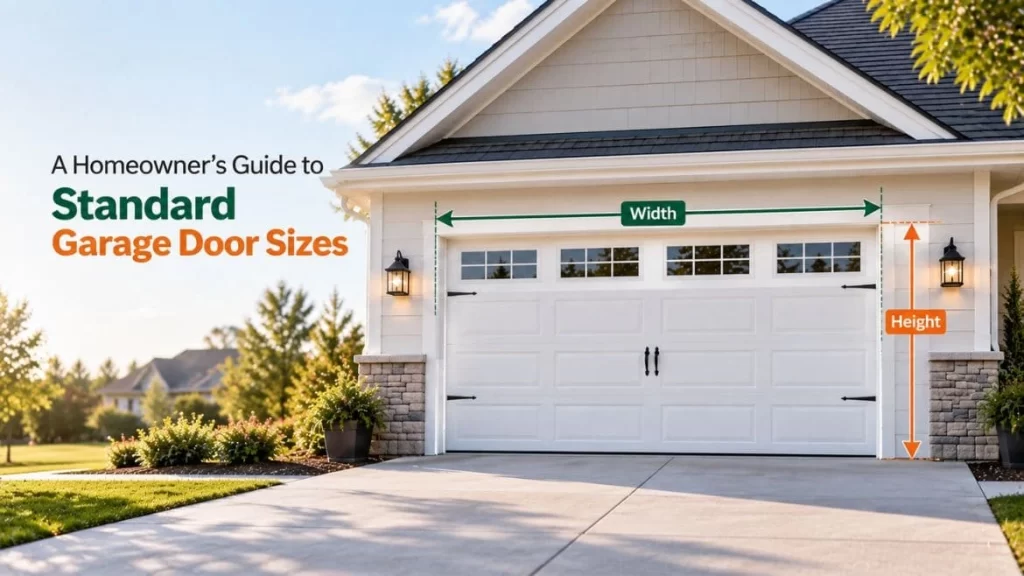
Choosing a new garage door starts with one important question: What size garage door do I need?
Fortunately, most residential garages use a few common dimensions. A standard single-car garage door is typically 8 or 9 feet wide and 7 feet high, while a standard two-car garage door is commonly 16 feet wide and 7 feet high.
However, those aren’t the only options. Your vehicle, garage layout, ceiling height, storage needs, and future plans can all affect the right door size.
If you’re considering a new garage door installation, this guide explains the most common garage door sizes, how to measure your garage opening, and when a custom size may be a better choice.
| Get Help Choosing a Garage Door – Call 209-484-8977 |
Let’s Take a Look at the Standard Garage Door Sizes.
The most common residential garage door dimensions are:
| Garage Type | Common Garage Door Size |
| Single-car garage | 8′ × 7′ |
| Single-car garage | 9′ × 7′ |
| Two-car garage | 16′ × 7′ |
| Wider two-car garage | 18′ × 7′ |
| Taller garage doors | 8′, 9′, or 10’+ high depending on the application |
These are common sizes, not universal requirements. Older homes, remodeled garages, larger vehicles, RVs, and garages with unusual openings may require different dimensions. That’s why measuring the opening and available clearance is important before ordering a replacement door.
What Is the Standard Single-Car Garage Door Size?
For a single-car garage, the most common options are 8 feet wide by 7 feet high and 9 feet wide by 7 feet high.
- An 8-foot-wide door is a common choice for smaller cars, sedans, and compact SUVs.
- A 9-foot-wide door gives you an extra foot of clearance, which can make parking and getting in and out of your vehicle a little easier.
If you drive a larger SUV, truck, or van, that additional width can be especially useful.
1. 8-Foot-Wide Garage Doors
An 8-foot door is a common choice for a smaller single-car garage. It can provide adequate clearance for many passenger vehicles while leaving room on either side for storage.
However, the vehicle itself isn’t the only consideration. Think about how much room you need to open your car doors, move equipment into the garage, or install shelving along the walls.
2. 9-Foot-Wide Garage Doors
A 9-foot-wide door provides more clearance than an 8-foot door without requiring a completely different garage configuration.
For homeowners with larger vehicles, the extra space can make everyday use more convenient. If you’re planning a garage door replacement that you can rely on, it may be worth comparing both sizes before choosing a replacement.
What Is the Standard Two-Car Garage Door Size?
The most common 2-car garage door size is 16 feet wide by 7 feet high.
A 16-foot-wide door provides enough opening width for two vehicles to park inside the same garage. It remains one of the most common standard double garage door sizes for residential homes.
Some garages use an 18-foot-wide door instead. The additional width can provide more clearance for larger vehicles and make it easier to maneuver around the garage.
One 16-Foot Door or Two Single Doors?
A two-car garage does not necessarily need one large garage door. Some homeowners choose a single 16-foot-wide door, while others prefer two separate single-car doors.
A single double door can create a clean, symmetrical appearance and requires only one opener. Two single doors provide more flexibility because you can open one side without opening the entire garage.
Neither option is automatically better. The right choice depends on your garage layout, vehicle use, appearance preferences, and installation requirements.
Does Garage Door Size Depend on Your Vehicle?
Yes. Your vehicle should be one of the first things you consider when choosing a garage door.
A compact car may fit comfortably through a standard 8-foot-wide door. A large SUV or truck may be easier to maneuver through a 9- or 10-foot-wide opening.
Height is also an important factor. So before choosing a door, consider:
- Your vehicle’s height and width
- Side mirrors
- Roof racks or cargo carriers
- Lift kits or larger tires
- Future vehicle upgrades
- Space needed to open vehicle doors
Choosing a door based only on the size of your current vehicle can also create problems later. If you’re planning to purchase a larger truck or SUV, consider whether the garage door will accommodate it.
How to Measure a Garage Door
Knowing how to measure a garage door is essential before purchasing a replacement.
Simply measuring the existing door isn’t always enough. You also need to consider the opening, ceiling clearance, side room, and available space inside the garage.
Here are the main measurements to check.
1. Measure the Garage Door Opening
- Measure the width of the garage door opening from one side to the other.
- Then measure the height from the garage floor to the top of the opening.
- Take measurements at multiple points rather than assuming the opening is perfectly square. If the measurements differ, note the smallest measurement.
2. Measure the Side Room
Side room is the amount of space available on each side of the garage door opening. This space is needed for tracks, springs, and other hardware. The exact clearance required depends on the garage door and hardware system being installed.
If side room is limited, a garage door professional should evaluate the opening before you order a door.
3. Measure the Headroom
Headroom is the distance between the top of the garage door opening and the ceiling or nearest obstruction.
Look for anything that could interfere with the door or opener, including:
- Ceiling beams
- Pipes
- Light fixtures
- Storage
- Ductwork
- Other equipment
Limited headroom doesn’t necessarily mean a garage door cannot be installed. Different hardware configurations may be available.
4. Measure the Backroom
Backroom is the distance from the garage door opening to the back wall. The door and opener need enough room to operate correctly when the door moves into the open position.
If the garage is unusually shallow, tell the installer before selecting the door and opener.
Garage Door Rough Opening Dimensions vs. Door Size
One common mistake is assuming the rough opening and the finished door dimensions are always interchangeable.
The garage door rough opening is the framed opening where the door will be installed. The actual requirements can vary depending on the door model, track system, framing, and installation method.
That’s why ordering a door based on one measurement alone can lead to problems.
If you’re unsure about your measurements, having a garage door expert evaluate the opening can help prevent ordering the wrong size.
When Do You Need Custom Garage Door Sizes?
Standard sizes work for many homes, but not every garage was built around standard dimensions.
You may need custom garage door sizes if you have:
- An oversized or unusually shaped opening
- An RV, camper, or large vehicle
- A lifted truck or vehicle with added height
- An unusually low or high ceiling
- An older garage with nonstandard dimensions
- A custom-built garage with unique requirements
For example, taller garage doors can be useful for RVs, large trucks, or vehicles with roof-mounted equipment.
Custom doors can also be designed around unusual architectural dimensions. However, they may cost more and can take longer to manufacture than standard doors.
Should You Choose a Wider or Taller Garage Door?
There is no single answer because the best garage door size depends on how you use the space.
Consider a wider door if:
- Your vehicle is difficult to maneuver through the current opening.
- You have a large SUV or truck.
- You want additional clearance around your vehicle.
- You plan to purchase a larger vehicle.
Consider a taller door if:
- Your vehicle is unusually tall.
- You have a lifted truck.
- You use roof racks or other equipment.
- You need additional vertical clearance.
A larger door isn’t automatically better. Increasing the size can affect the available space for tracks, springs, openers, and other hardware.
What About Garage Door Thickness and Insulation?
Size is only one part of choosing a garage door.
You should also consider the door’s construction and insulation, particularly if your garage is attached to your home or used as a living, work, or storage area.
Insulated garage doors can help improve temperature control and reduce outside noise. They can be especially useful where summer temperatures can be high.
If the garage is primarily used to park a vehicle and isn’t connected to conditioned living space, you may have different insulation priorities.
The important thing is to choose the door based on how you actually use the garage rather than paying for features you don’t need.
How Do You Know Which Garage Door Size You Need?
Start with four questions:
- How many vehicles will use the garage?
- What are the dimensions of those vehicles?
- What are the width and height of the garage opening?
- How much side room, headroom, and backroom are available?
For many homes, a standard 8- or 9-foot-wide door works well for a single-car garage, while a 16-foot-wide door is a common choice for a two-car garage. Larger vehicles or unusual garage openings may call for a wider, taller, or custom door.
The goal isn’t simply to choose the most common size. The door should fit the opening comfortably and give you enough room to use your garage and park your vehicles without feeling cramped.
| Get a Garage Door Estimate – Call 209-484-8977 |
Frequently Asked Questions About Garage Door Sizes
What is the most common garage door size?
The most common residential garage door sizes include 8′ × 7′ and 9′ × 7′ for single-car garages and 16′ × 7′ for two-car garages.
How wide is a standard garage door?
A single-car garage door is commonly 8 or 9 feet wide. A standard two-car garage door is commonly 16 feet wide, although 18-foot options are also available.
What should the standard garage door height be?
A 7-foot height is common for residential garage doors. Eight-foot-tall doors are also available, while taller doors may be appropriate for RVs, trucks, and other oversized vehicles.
What size garage door do I need for two cars?
A 16-foot-wide garage door is a common choice for a two-car garage. An 18-foot-wide door may provide additional clearance for larger vehicles.
Can I install a taller garage door?
Possibly. An 8-foot-or-taller garage door may work if the garage opening and available headroom can accommodate it. Larger vehicles may also require custom dimensions.
Are garage doors available in custom sizes?
Yes. Custom garage door sizes are available for garages that don’t accommodate common residential dimensions or for homeowners with oversized vehicles and specialty needs.
Area We Serve
| Garage Door Replacement Modesto | Garage Door Replacement Stockton |
Takeaway
The most common residential garage door sizes are 8′ × 7′ or 9′ × 7′ for single-car garages and 16′ × 7′ for two-car garages. But the correct size depends on more than the number of vehicles you park.
Before ordering a new door, measure the garage opening, side room, headroom, and backroom. If your garage has unusual dimensions or you have an oversized vehicle, a custom solution may be the better choice.
Read More About:
- How To Choose The Best Garage Doors for Modern-Style Homes?
- Creative Ways to Reuse or Recycle Your Old Garage Door
- Why Your Garage Door Gets Stuck More Often in Hot Weather
- Why Your Garage Door Looks Crooked: Cable Damage Explained
Trust A Dependable Overhead Door Co. for the Right Garage Door in Modesto
Choosing the right garage door size is easier with accurate measurements and professional guidance. Whether you need a garage door replacement, new door installation in Modesto, or help with an unusual garage opening, A Dependable Overhead Door Co. can help you find an option that fits your garage, vehicle, and budget.
As a BBB-accredited garage door company with an A+ rating and over 20 years of experience, we deliver reliable solutions tailored to your garage layout and budget.
From initial measurements to expert garage door service in Modesto, we make sure your door fits perfectly every time.
Ready to upgrade your garage door? Call 209-484-8977 to discuss your garage door needs, schedule a professional garage door inspection in Modesto, and find the right size for your home, vehicle, and budget.